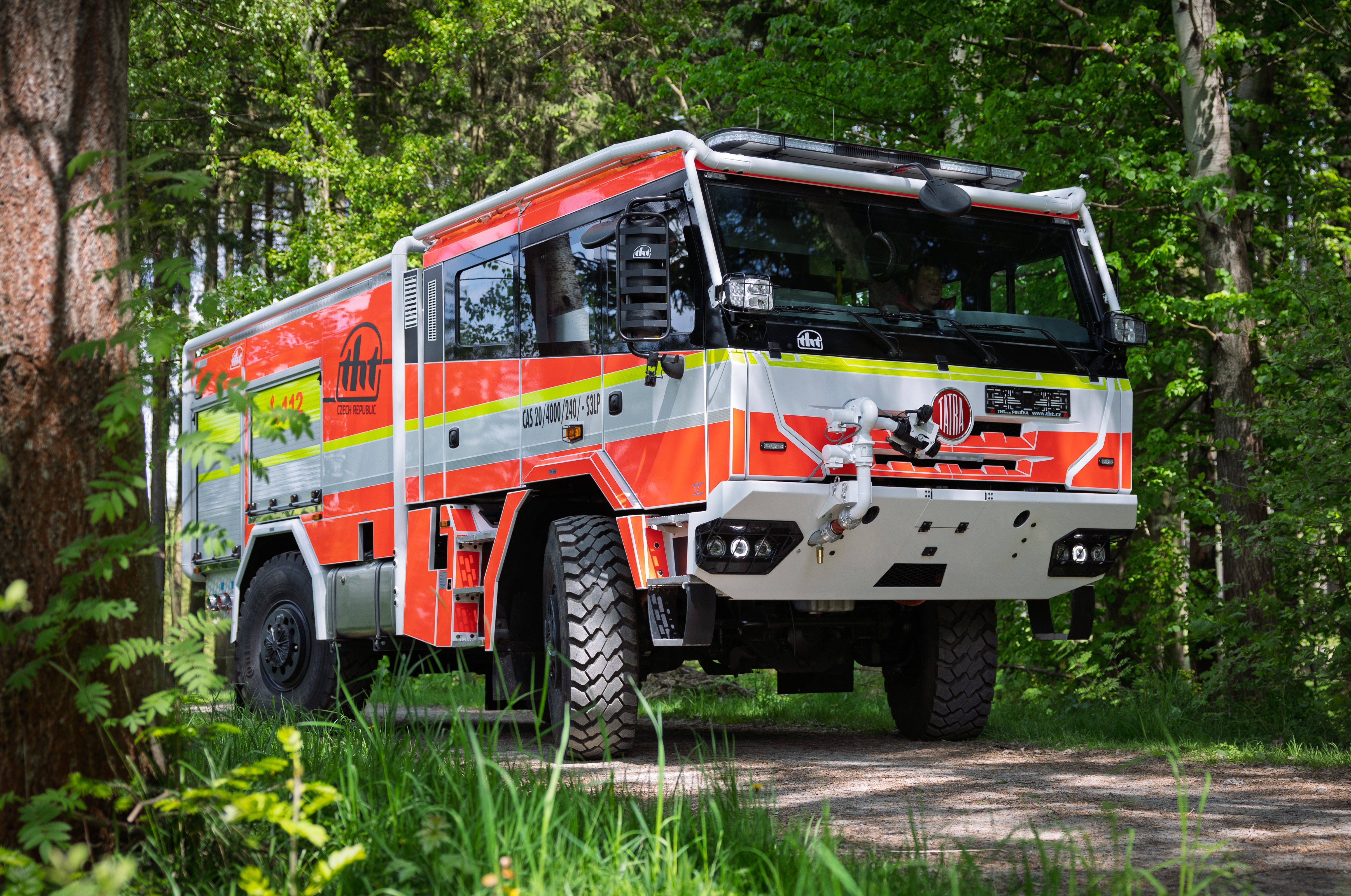
New Tatra Force CAS 20 firefighting special vehicle for fighting forest fires with the possibility of crab running
3.12.2025
The new Tatra Force CAS 20/4200/252 – S3LP forest special vehicle with a firefighting superstructure made by THT Polička is a special vehicle designed for intervention in the most difficult terrain and in forest fire conditions. The chassis of the Tatra Force 3rd generation series has a proven Tatra concept with a central backbone tube and swinging independently suspended half-axles, while the truck also has modern equipment and technical solutions focused on durability, crew safety and efficiency during intervention.
The new ultimate Tatra Force CAS 20 special vehicle was designed and built based on discussions with many users, especially with firefighters with experience in extinguishing fires in Czechia, Greece and other emergencies in extreme conditions. The vehicle is 7800 mm long, 2600 mm wide and 2990 mm high, and can ford water obstacles up to 1200 mm deep. The turning circle is only 15 meters; the approach angles are 35 degrees in front and rear. The highest technically permissible weight of the vehicle is 19 tons and the maximum speed with the limiter reaches 110 km/h, which meets the requirements for both fast movement on roads and work in difficult terrain.
Proven Tatra chassis and engine, cab meeting ROPS regulations
The all-metal single-space four-door cab is four-seater, supplemented by two emergency seats. To ensure the comfort of the crew, it is equipped with independent heating. The cab meets the ROPS regulations for crew protection in the event of a rollover, with protective elements integrated directly into its structure. In addition, it is complemented by an external tubular protective frame, which is also included in the bodywork. These are intended to prevent damage to the vehicle when passing through forest.
The basis of the vehicle is the Tatra Force T 815-75RA1T39A00 4x4.1R chassis with a wheelbase of 3900 mm. The chassis is equipped with an electronic steering system that allows hydraulic steering of the rear axle as well. The system can be deactivated from the driver's seat as needed; when the speed exceeds 50 km/h, the rear axle is automatically centred, and its steering is locked. The electronic steering system has three modes. The Manual Steering mode allows steering of the wheels of the second axle completely independently of the position of the front wheels. The All-Wheel Steering mode sets the steering of the wheels of the second axle in connection with the steering position of the front wheels, which serves to reduce the turning radius and improve manoeuvrability. The Crab Steering mode allows the wheels of the second axle to be turned in the range of 0 to 21 degrees in the same direction as the wheels of the front axle, thus allowing movement diagonally, for example along obstacles.
The vehicle is powered by an eight-cylinder air-cooled Tatra T3-928-RE 12.7 litres engine and with an output of 340 kW, meeting the Euro 5 emission standard. The Allison 4500 transmission is automatic, with a hydrodynamic torque converter and is equipped with an auxiliary drive for driving the fire pump, which allows its operation up to a vehicle speed of 10 km/h. By regulating the air pressure in the vehicle's suspension system, the vehicle's ground clearance can be changed from the driver's seat in the range of -120 to +90 mm. The chassis is also equipped with central tire inflation, which can change the tire pressure while driving, thus improving cross-country ability in extreme terrain. The brakes are drum on all wheels, taking into account operation in very difficult terrain with a high probability of heavy chassis contamination. To increase the vehicle's durability in demanding conditions, the compressed air distribution, electrical wires and fuel distribution are equipped with protective sleeves that can withstand temperatures of 200 °C for a long time and can withstand temperatures of up to 1000 °C for 15 minutes.
Body with aluminium elements and durable control display
The purpose-built body is divided into three separately attached parts. It consists of a protective frame, a water tank and foamer with integrated side compartments, and a rear compartment for accessories and pumping equipment. The frame of the rear compartment is screwed together from aluminium profiles and covered with aluminium sheet metal. The interior of the compartment is made of aluminium profiled sheet metal; the same sheet metal is also used on the upper platform of the compartment. The side openings of the compartments are covered with aluminium roller shutters with a continuous handle. At the rear, a hinged door with gas struts is mounted upwards, supplemented by a roller shutter, which covers the compartment with pumping equipment. On the right side of the rear wall there is a ladder used to access the upper working platform.
The cabinets are illuminated by LED strips on the side pillar, and the opening of the cabinets is signalled on the driver's instrument panel. Shelves for accessories are made of aluminium sheet metal and allow for variable placement of fire equipment. The large fire equipment is stored in a box with a light metal lid on the upper platform of the body. The box is illuminated and lockable and uses the same key as the roller shutters. The Tatra is equipped with a hydraulically driven cable winch. The winch is located behind the front bumper, has a pulling force of 38 kN and is equipped with a 30-meter cable, which facilitates the rescue or securing of the vehicle in difficult terrain.
The control LCD display of the superstructure is housed in a robust housing designed for demanding conditions. It has very good readability in all lighting conditions and, thanks to the closed operating system, has increased cybersecurity, which reduces vulnerability to unauthorized interference. The LCD display meets the requirements for electromagnetic compatibility in the automotive environment (EMC Automotive), while also meeting the conditions for earthmoving and construction machinery and for road vehicles. It is resistant to vibrations and impacts, and its design meets the conditions for water ingress into the device according to the IP66K protection level. The reliability of the display is guaranteed in the operating temperature range from -30 °C to +70 °C, which allows its use in a wide range of climatic conditions. The display has a diagonal of 10.1" with an aspect ratio of 16:10 and a resolution of 1280 × 800 at a display resolution of 149 PPI. The front is covered with tempered glass, the control part consists of ten silicone keys with backlighting, the functions of which can be configured in software according to the needs of the operation.
Powerful jets and protective nozzles of the cabin and body
The water tank and foam agent form a single unit. It is made of glass-fibre reinforced polyester. The vehicle can carry 4200 litres of water and 252 litres of foam agent. In the rear part of the tank, there are storage compartments on both sides closed by aluminium roller blinds with continuous handles, which complement the storage options of the entire vehicle. A THT PKA 2000–400 fire pump, driven by the vehicle engine, is mounted in the rear body box. The pump allows intervention using low or high pressure, or combined operation of both. modes.
The special is equipped with two water jets. The upper jet is located on the superstructure and is removable. Its flow rate is adjustable in the range of 500 to 2000 litres per minute, and the effective spray range reaches 50 meters. A stand for use outside the vehicle is also included. The jet on the vehicle bumper has a flow rate of 200 to 800 litres per minute at a pressure of 6 bars and is controlled by a proportional joystick and push-button controls from the vehicle cabin. Optionally, a remote control with a cable can be used, and the jet can also be set to a repeating path of movement by the user.
The equipment includes a 60-meter high-pressure hose. It is dimensionally stable, fully flowable and flexible along its entire length and has a smooth surface, which makes handling easier. A combined high-pressure jet with a variable jet shape at an optional constant flow rate is connected to the hose. The hose allows drainage with compressed air connected to an air chassis system, which simplifies its emptying after the intervention.
The vehicle is equipped with two circuits of protective nozzles. The first circuit protects the chassis and wheels of the vehicle from radiant heat. The nozzles of the second circuit are located on the roof and protect the crew cabin and the body from radiant heat. Both circuits are supplied with water from the vehicle's fire pump, and the system electronically stops operation if the water level in the tank reaches the set limit. The operator can then decide whether to use the remaining amount of water for extinguishing the fire itself or to keep it for further protection of the vehicle.